
by Saara Koikkalainen, Karelian Institute, University of Eastern Finland
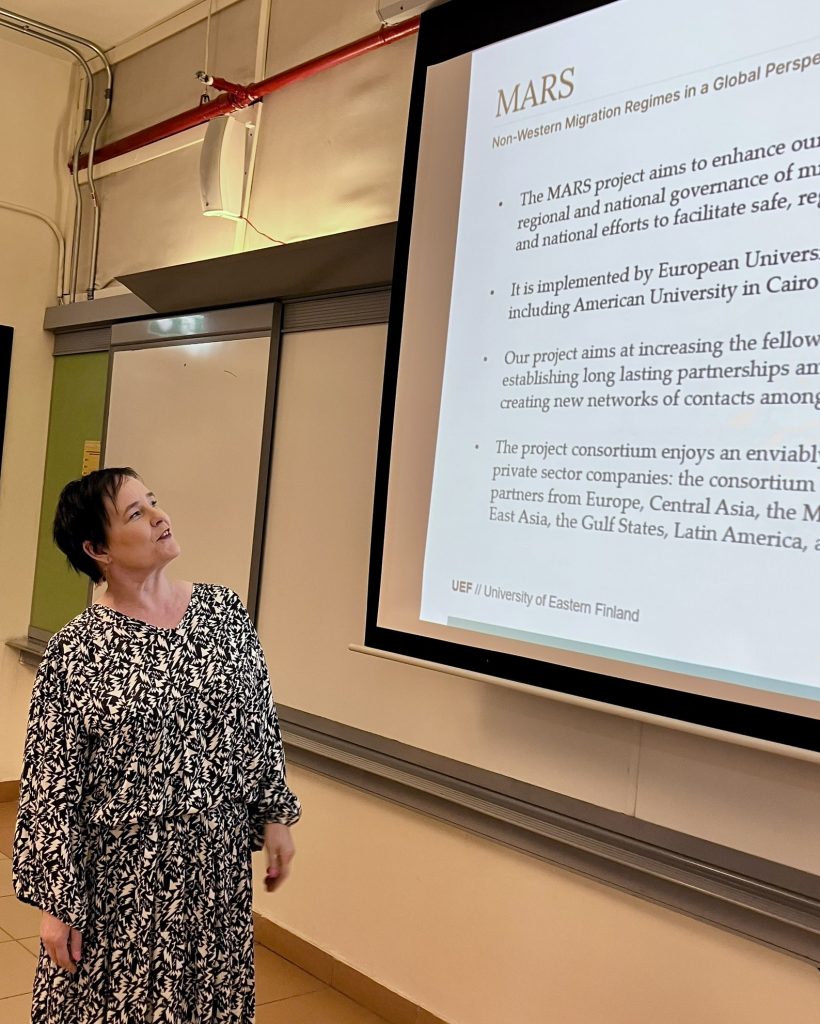
I had the pleasure of visiting the American University in Cairo (AUC) on a MARS project secondment in November-December 2025. Apart from knowing that Egypt is a key regional hub of migration, my knowledge of the country before the visit was limited, so I knew the experience would be very educational, both personally and professionally. Egypt occupies an important position along key migration routes connecting East Africa and the Horn of Africa to Europe, and it is situated in an unstable geopolitical setting. There is a civil war in Sudan to the south, instability in Libya to the west, and Israel’s war on Gaza to the east.
From Europe’s perspective, Egypt appears as a gateway for irregular migration to Europe. The European Union (EU) sees the country very much in this light, and it has been collaborating with Egypt since 2016 to stem the flow of migrants to Europe via the Central Mediterranean route. From 2024 to 2027, the EU is investing significantly in Egypt. The funding includes €5 billion in loans with favourable terms, €1.8 billion in additional investments to be mobilised, and €600 million in additional grants, of which €200 million is earmarked for migration management. Thus, these amounts are more significant than the previous EU efforts to stem the arrival of irregular migrants, including the so-called 2015 EU-Turkey deal, i.e. the EU Facility for Refugees in Turkey, which was initially worth €3 billion, with an additional €3 billion later.
A key factor in this generosity is the EU’s fear of a large number of displaced persons that might head towards Europe via Egypt. As of December 2025, 1,085,000 refugees and asylum seekers are registered with UNHCR Egypt, with 822,000 originating from Sudan, where a brutal civil war broke out in April 2023. Not all those fleeing the conflict have registered with the UNHCR, and the Government of Egypt states that the country hosts up to 1,5 million displaced Sudanese. The world’s most damaging displacement crisis is visible in the streets of the greater Cairo area and especially in Faisal (Giza Governorate), where the newly arrived have settled in the neighbourhoods where many Sudanese were living already before the war.
During my stay at AUC, I was fortunate to be invited to several events and field visits, where the situation of the Sudanese in Egypt was discussed. The first was a conference organised by CEDEJ Khartoum and the French Institute in Egypt, called Lives in Displacement: Sudanese migration in Egypt since April 2023 (November 12-13, 2025). Very suitably for the themes of the MARS project, my AUC contact persons, Assistant Professor Gerda Heck and Assistant Professor Amira Ahmed, gave an excellent keynote talk titled ‘Changing dynamics of migration in the Global South – Egypt as an example’. The program was a captivating deep dive into how long-standing transnational networks and innovative coping mechanisms were used at a time of an unprecedented conflict.
Another very interesting experience was getting to know the work of the Tafawol Association, which was founded in 2016 as a refugee-led community organisation. From a small initiative to support children with special needs within local schools, it has evolved into a multi-site, integrated institution offering comprehensive services to support refugees and migrants. The organisation runs a community school that follows the Sudanese curricula and serves more than 1,000 children, for example. Along with the knowledgeable staff of the organisation, another of my AUC contacts, Elena Habersky, was kind enough to introduce me to the work of Tafawol, as she is volunteering at the association as part of her PhD thesis fieldwork.
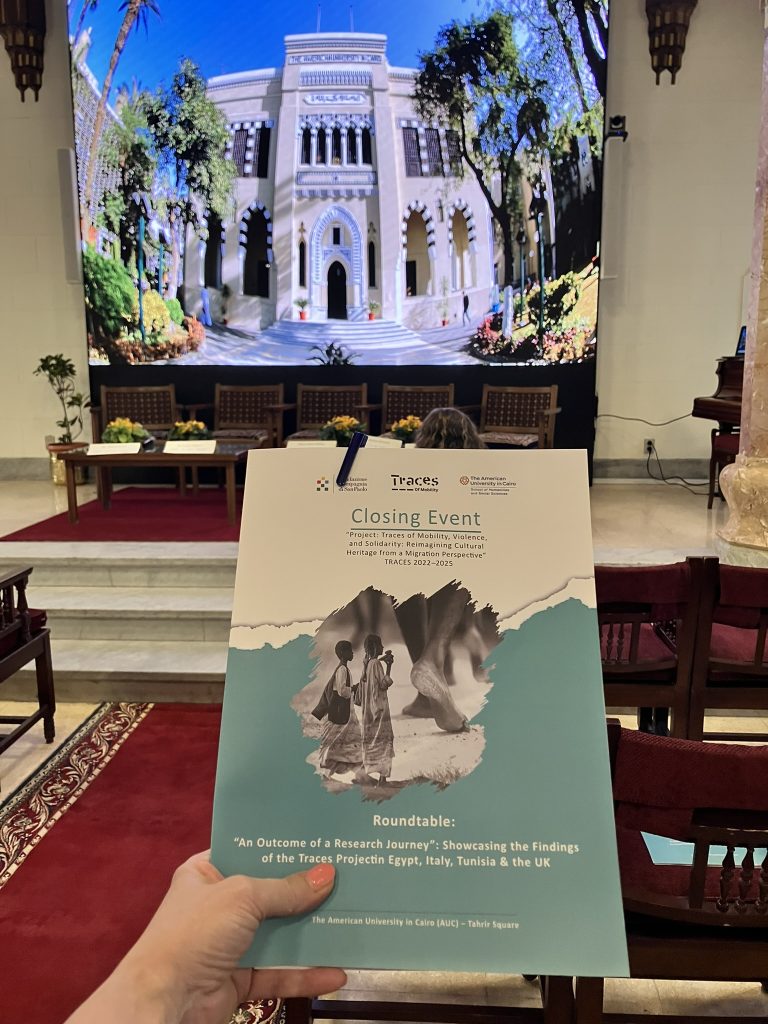
Another key event during my time in Cairo was the closing seminar of the Traces of Mobility project (November 30th, 2025). The international project examined migrants’ trajectories between Sudan, the Horn of Africa, Egypt, Libya, Tunisia, and Italy, in the context of war and political and structural violence. In such situations, migrants’ voices and memories are often ignored and marginalised, even though they represent important aspects of the cultural history of those on the move. The project showcased how it is possible and very fruitful to combine migration research with participatory approaches and cultural and musical events and performances that also benefit the migrant communities in question.
My two-month stay in Cairo went too quickly to my liking, as Egypt, as a country, is so diverse and full of history that it would take a much longer stay to begin to understand how migration shapes the country today. I am deeply grateful to the MARS team for this opportunity and especially to Gerda, Amira, and Elena for their kind help and incredible friendship. We will continue collaboration for sure in the future.
