
by Dr Leander Kandilige, Centre for Migration Studies, University of Ghana
I was excited by the framing of the MARS project around “Non-Western Migration Regimes in a Global Perspective”. This is apt given the recent advocacy on balancing the academic scales by encouraging co-production of knowledge as well as decolonising migration research. Narratives on skewed Euro-North American centric theorisation and methodological approaches to the study of migration have dominated academic discourse and conferences but few practical actions have been taken to actually walk the talk. Lamentation or giving voice is good in terms of shining a torch on a neocolonial framing of what and whose knowledge is good knowledge, but this is insufficient in realigning epistemological and ontological eurocentrism.
The MARS fellowship at Leiden University was an excellent opportunity for me to meet, interact, and to challenge the broad range of knowledges that exist in Social Science, especially in the area of Migration Studies. I reached out to a migration scholar and MARS team member, Dr. Katharina Natter, to serve as host during my stay in the Netherlands. Planning for my fellowship was dominated by the difficulty in getting accommodation in Leiden or even neighbouring communities. The advertised rent charges were way above what the fellowship funding could afford! I ended up renting a bed in a one-bedroom flat of an old acquaintance of mine in Den Haag (the Hague) as my accommodation for my two-month stay in the Netherlands. This was less than ideal but luckily, my proactive host quickly guided me on how to navigate the Leiden University system (both the Leiden and the Hague campuses). This included registration for a Leiden University card (popularly known as a LU Card), access to the university email platform, keys to the shared space at the FSW building in Leiden, participation in free lunches on the first Thursday of the month, lunchtime seminars as well as free tea/coffee at the faculty common room, among others. Lunch time seminars addressed very interested topics including “The Lies that Bind: The Politics of Official Deception about Police Killing” by Prof. Nicholas Rush Smith; “Social distance in International Relations” by Prof. Hilde van Meegdenburg and “Cartel Parties in Africa – A Research Project” by Prof. Matthijs Bogaards. For instance, the conceptualisation of “cartel parties in Africa” was very curious. It fed into narratives and discourses of ‘Africa as a country’. As a diverse continent with different political histories and party-political experimentations across time and space, this seminar provoked a lively discussion of the author’s approach to studying Africa as though the continent is a monolithic entity that is frozen in time.
To share my research, we first tried to secure a slot to present at the Leiden Interdisciplinary Migration Seminar (LIMS) series, which unfortunately was not possible in the end. However, through the tireless efforts of my host (Dr. Katharina Natter), I secured a slot to present my work to faculty members and students at the Institute of Political Science, Leiden University. The seminar was on the topic “Irregularisation across scales: From international to internal irregular migration in Ghana”.
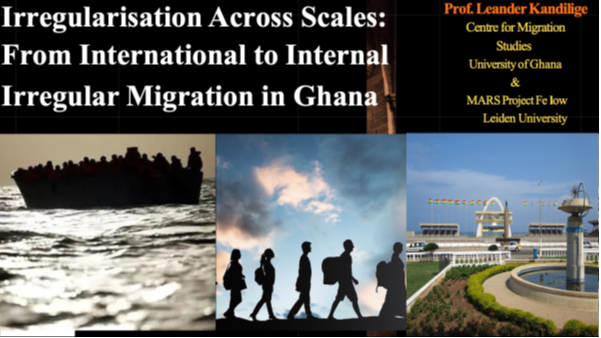
I noted that global literature on migration has largely been shaped by strenuous attempts at delineating categories of migration and affixing labels to apparently facilitate migration governance and control. I observed that while the regularity, or not, of international cross-border migration easily lends itself to categorisation because sovereign state laws are evoked against non-citizens, it is more complicated when such migrations are confined within a single state. Drawing on a large set of qualitative and quantitative data, my paper (co-authored with Dr. Cathrine Talleraas) examines how Ghanaian state agencies, civil society organisations and local communities conceptualise the migration of young adults from the north to the south of Ghana, particularly those performing hazardous or informal jobs. These internal movements, though fully permitted under Ghana’s constitution, are often framed by institutions as “irregular.”
This raises important conceptual challenges: what constitutes the perceived “irregularity” in these cases? Is it a question of legal status and border crossing practices, or of risks, hardships or social deviance? I averred that these tensions are sharpened when local interpretations of irregular movement intersect with globally circulating migration discourses – often shaped by institutions in the Global North. I argued that international policy frameworks and donor-funded initiatives have helped entrench normative associations between “irregular migration” and cross-border mobility marked by danger, and specifically migrations that represent a political challenge in receiving societies, e.g. in Europe. I noted that these framings are increasingly internalised and reinterpreted in local contexts, where they are applied to diverse migration practices – including, as in Ghana, to internal mobility and this falls outside formal regulation.
In this paper, we treat “irregular migration” not as a fixed or self-evident category, but as a label that is actively applied by institutional actors – especially within migration governance and civil society actors. We introduce the concept of “irregularisation” to describe how internal migrants are categorised as irregular based on perceived risk, danger or social or moral deviance, rather than on legal grounds. Our analytical focus is on how these framings are constructed, operationalised, and contested. Unlike international migration where illegal activities, such as unauthorised border crossing, overstaying of visas, or violation of entry conditions, can lead to the irregularisation of migrants’ status, we find a narrower trend that plays out in contexts in Ghana. Our research suggests that migration by unaccompanied minors, migration without permission of parents/guardians and migration to engage in jobs that might negatively affect the health and wellbeing of migrants are irregularised, despite not breaching any laws. I received constructive feedback from participants at the seminar where some sought clarification on why state authorities choose to adopt the term ‘irregular’ internal migration, a suggestion to expand the discussion on “street level bureaucracy” among others. These inputs and questions are being used to strengthen the paper.
Beyond the seminar presentation, the fellowship enabled me to participate in related academic encounters that focus on levelling the playing field on projecting knowledges and epistemes from a multipolar world as equally worthy. In line with this, I attended a meeting of the Steering Committee of the International Panel on Migration (IPM) in Berlin, Germany on the 28th and 29th of October 2025. The IPM aims to be an action-oriented scientific organisation, rooted in scholarly rigour and collective intelligence. It will translate the results of academic research on migration and mobility into public debate and, in doing so, inform and influence public understanding, discourse, and policymaking. This helps to deal with the growing disconnect between science, public perception and understanding, and political discourse in the field of migration. Such an approach helps to overcome the fragmentation of scientific communities, and the marginalisation of critical and non-Western knowledge and promote academic freedom. Moreover, it addresses the instrumentalisation of migration in politics and the erosion of trust in scientific knowledge. Ultimately, by structuring and amplifying a pluralistic, reflexive, and globally representative scientific voice, the IPM aspires to reassert the legitimacy and utility of sciencein one of the most contentious domains of national politics and global governance.The vison of the IPM neatly aligns with the tenets of the MARS Project.
To expand critical conversations on bridging the gap in migration scholarship, I served as a panelist at an online seminar on the 14th of November 2025 organized by the Institute for Migration Studies, Lebanese American University and the Refugee Law Initiative, School of Advanced Study, University of London on the theme “Ethical futures in research and publishing: centering ethics, access and equity in refugee studies”. This provided an opportunity for frank conversations on ethical research in refugee studies, publication challenges faced by global southern scholars and the role of diverse editorial boards in assuaging the growing gulf between academics based on where they are geographically located.
Furthermore, in the spirit of exploring ways of promoting theorisation and innovative global-southern focused methodological approaches, I attended a workshop at the Georgetown University in Qatar entitled “Migration studies from the Global South: rethinking theory and method”. This took place on the 16th and 17th of November 2025. I had the privilege of leading discussions on unpacking the migration-development nexus from a global southern perspective. This workshop aims to lead to the formation of research clusters across global southern countries on topical migration research issues and as a springboard for more equitable academic collaborations with global northern academics.
Ultimately, the fellowship facilitated discussions on possible collaborations with faculty and students at Leiden University who are carrying out research into different aspects of migration studies. I engaged with faculty and students of both the Institute of Political Science and the African Studies Centre. These discussions have helped to map out areas of common research interest that could form the basis for joint research projects or grant applications. Areas under consideration include research on labour migrations to the Gulf States, migration and climate change in West Africa, regional integration and the ECOWAS Free Movement protocol, and institutional frameworks for managing incidents of human trafficking in Ghana. Two students from Leiden University will visit Ghana to conduct fieldwork, under my supervision, for a ten-week period.
