
By Vokhid Rakhimov, Kurultai Research and Consulting (Tashkent)
When I arrived in Istanbul for my research secondment at the Özbek Kadın Hakları Derneği (Uzbek Society for the Protection of Uzbek Women), the city immediately struck me as a place where worlds meet. The lively streets of Fatih and Aksaray, where Central Asian accents mingle with Turkish, Arabic, and Russian, revealed Istanbul as a unique site of cultural layering — both a destination and a transit hub for countless migrants from our region.
This research stay, undertaken within the framework of the EU-funded MARS project, allowed me to explore a theme that is becoming increasingly central in migration studies: the educational mobility of Central Asian students to Turkey. Turkey’s linguistic and cultural proximity to Central Asia, combined with its growing higher-education sector and scholarship programmes, has made it a magnet for young people seeking opportunities abroad. Yet, as I learned through both literature and fieldwork, the path of education migration is rarely straightforward. It involves adaptation, negotiation, and continuous learning — academically, socially, and personally.
Turkey is among the leading countries in the world hosting a large number of international students. According to the Turkish migration authorities, more than 180,000 foreigners held student residence permits in Turkey at the beginning of 2025. As shown in Figure 1, Turkmenistan (42,432), Uzbekistan (8,904), and Kazakhstan (7,202) were among the top ten countries with the highest numbers of students enrolled in Turkish public and private universities.
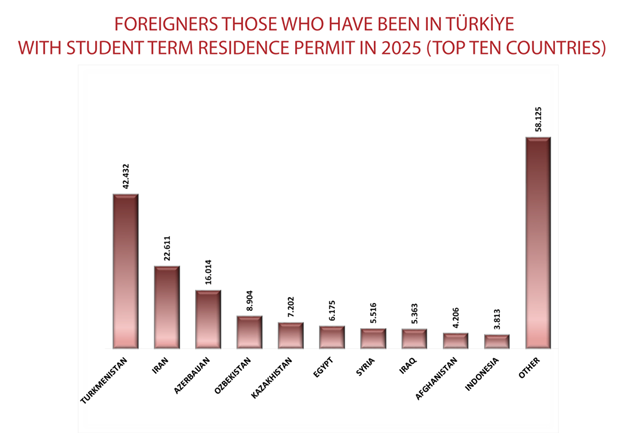
Figure 1. Top ten countries with students in Turkey in 2025. Source: https://en.goc.gov.tr/residence-permits
Fieldwork among Central Asian Students
During my stay, I met with Uzbek, Kyrgyz, and Kazakh students studying at universities in various universities across Istanbul. Their stories reflected both optimism and complexity. For many, Turkey represented a “familiar foreign land” — culturally close, yet institutionally and linguistically distinct.
One of the most recurrent issues was language. Despite linguistic kinship between Turkish and Uzbek, academic Turkish proved demanding. As many of my contacts highlighted, insufficient mastery of Turkish affects students’ reading comprehension, writing, and ability to participate confidently in class discussions
In particular, one student from Uzbekistan recalled: “In my first semester, I could sense the professors’ tone but not their meaning.” Over time, these linguistic challenges evolved into sources of resilience — shaping students’ ability to bridge cultures through language.
Financial and social adaptation also emerged as key themes. During my encounters I was able to see that many international students in Turkey face financial constraints, homesickness, and limited engagement with local peers. Scholarship schemes such as Türkiye Bursları are deeply appreciated, yet living costs in Istanbul stretch budgets thin. Many students engage in part-time work to sustain themselves. Still, students valued the experience: “We are not just studying here; we are building bridges between our countries,” one Kyrgyz student said.
Gender and Educational Mobility
My secondment was hosted by an organisation working primarily with migrant women. This environment gave me a unique vantage point to observe the gendered dimensions of educational migration. I encountered young Uzbek, Turkmen and Kyrgyz women balancing their academic ambitions with social expectations and family responsibilities. The Özbek Kadın Hakları Derneği offers crucial support — from language tutoring and counselling to informal peer networks that help women navigate both bureaucratic systems and personal challenges.
Gender, as I learned, is not only a demographic variable but a structuring force shaping how education mobility is experienced. For many Central Asian women, studying in Turkey represents both an academic opportunity and a subtle form of empowerment. As one student put it, “Here I learn not only my subject, but how to speak for myself.”
Education Migration in a Global Context
This fieldwork resonates with broader discussions about migration and higher education found in other works. Scholars argue that higher education functions as a tool for social inclusion — enabling migrants and refugees to rebuild lives, identities, and professional futures.
Turkey’s case illustrates this duality vividly. It is simultaneously a country of refuge, a site of South-South educational mobility, and an arena of state soft power. Central Asian students navigate these overlapping regimes of opportunity and constraint, forming a distinct category of transnational learners who straddle multiple educational and cultural systems.
Reflections from the Secondment
Personally, the Istanbul secondment was an intellectually and emotionally enriching experience. Working closely with the Özbek Kadın Hakları Derneği allowed me to see how grassroots initiatives complement formal migration governance. In community meetings and workshops, I observed how migrants share knowledge — how to register for classes, apply for residence permits, or even negotiate with landlords. This reminded me that migration systems are sustained as much by informal solidarities as by official policies.
The MARS project’s emphasis on non-Western migration regimes resonates deeply with these realities. Turkey, situated between the post-Soviet and European spaces, embodies a hybrid model of migration governance — one that is both developmental and humanitarian, yet also shaped by its regional politics.
Looking Ahead
As I return to Tashkent, I carry not only empirical data but new insights and questions. How does education migration reconfigure identities and aspirations in the Turkic world? What informal networks sustain student mobility beyond state policy frameworks? And how can research collaborations between civil society and academia better support these mobile young populations?
Istanbul, with its layered histories and migrant dynamism, offered me both a research site and a mirror. It reminded me that studying migration is not only about policy or numbers — it is about people learning to belong in motion.
